Narnian army
The Horse and His BoyThe Narnian army is the military force that answers the attack on Anvard, turning a surprise assault into a joint victory for Narnia and Archenland. Its role is defined not only by its varied ranks and timely arrival, but by the contrast between Rabadash’s violation of peacetime and the Narnians’ understanding of war as a defense of an ally.
Mobilization and Strategic Context
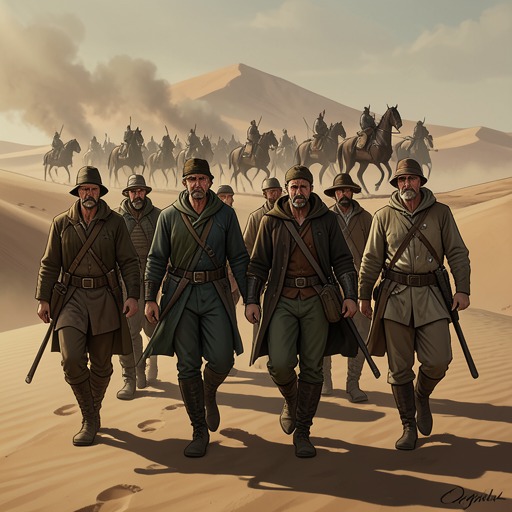
The need for an army arises from Rabadash’s plan to invade with two hundred horsemen. He proposes crossing the desert, seizing Anvard before its defenders can prepare, and then continuing through Narnia toward Cair Paravel. The plan depends on surprise and on the assumption that the High King will be away. Although Rabadash presents the expedition as limited and potentially deniable, its objective is an attack on Narnia as well as the seizure of Queen Susan.
The desert is a serious constraint on a larger invasion. Sallowpad explains that the Great Oasis cannot supply enough water for a great army and its animals, but describes another route from the Tombs of the Ancient Kings, past Mount Pire and through a concealed stony valley to a river leading into Archenland. This knowledge establishes that the desert does not make invasion impossible; the danger instead depends on the route, water, and how quickly news can reach those under threat.
Once news of the attack reaches Narnia, Duffle insists that a message must be sent to Cair Paravel and that the army must aid King Lune. The Hedgehog notes that King Peter is away in the north dealing with giants, but the absence of the High King does not prevent the response. The army’s purpose is stated as relief of an ally, not territorial conquest.
Composition and Leadership
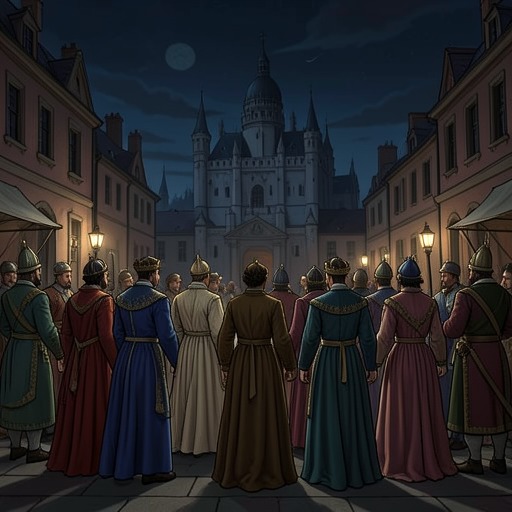
The army arrives under the great banner of Narnia, a red lion on a green field. Lord Peridan rides at its head; King Edmund and Queen Lucy ride with Corin, who has returned to the force from the events at Anvard. Queen Lucy wears a helmet and mail shirt and carries a bow and quiver, appearing among the leaders as a participant in the campaign rather than a distant court figure.
The force brings together human soldiers and Narnia’s speaking peoples. Its ranks include men on ordinary horses, men mounted on Talking Horses on this proper occasion of war, centaurs, bears, Talking Dogs, and six giants. The mixture makes the army more than a conventional body of human cavalry: it is a coalition of Narnian inhabitants assembled for a common defense. The narrative also registers that its composition can be startling to an observer unfamiliar with it; Shasta initially finds the giants difficult to look at, even though they are on his side.
Arrival and Battle at Anvard
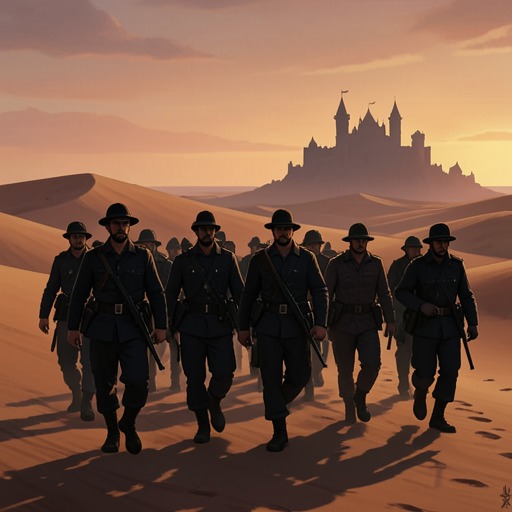
The army’s approach becomes audible before it is visible. Shasta hears trumpets and then the sound of horses, and the column appears from the eastern woods. It rides toward Anvard as the Calormenes are attacking the closed castle gate with a tree trunk used as a battering ram. The attackers had largely been on foot, but the sight of the Narnian force prompts them to remount and turn to meet it.
The charge brings the relief force into the battle while the castle’s defenders remain behind the walls. Shasta, riding with the advancing army, is frightened and inexperienced; in the confused clash he loses his sword and falls from his horse. His individual experience is therefore not that of a trained soldier directing the engagement, but of a boy caught in the dangerous uncertainty of a larger battle.
The outcome depends on pressure from several directions. The Hermit reports that the Great Cats have disabled the Calormenes’ riderless horses and then attack the men operating the ram, bringing it down. The gates open from within and King Lune leads a sortie with his men. The Calormene line is pressed between the defenders emerging from Anvard and the Narnian force: giants close in on one side, Cats on the other, while King Lune attacks from the rear. King Edmund fights in the engagement, and the Calormene force is eventually defeated; some surrender and others flee.
Victory, Captivity, and Political Meaning
After the battle, the castle gates stand open and the surviving Calormenes are prisoners. King Lune and King Edmund meet across the battering ram and shake hands, making visible the cooperation that has secured Anvard. The victory is therefore both military and political: the Narnian army’s intervention prevents Rabadash from taking the castle and supports the sovereignty of its ally, Archenland.
Rabadash demands to be released so that he can fight Edmund, but King Lune refuses. He distinguishes a challenge in peacetime from an attack made without warning: by assaulting Anvard while the countries are at peace, Rabadash has forfeited the standing of an honorable challenger. This judgment places a limit on the meaning of victory. The army has defeated the invaders, but the response to their prince is governed by the law of peacetime and the rules of honor, not simply by the opportunity for further combat.
King Lune later offers to release Rabadash unharmed under conditions, citing both prudent policy and his youth and upbringing. Rabadash rejects the offer while still in chains. The episode thus sets the Narnian army’s forceful defense of Anvard against the conduct of an invader who treats a peaceful neighbor as an easy target, while the settlement after battle remains subject to political judgment and restraint.